Is It Still Worth Learning to Code When Tech Feels Broken? Is Coding Worth Learning in 2026?
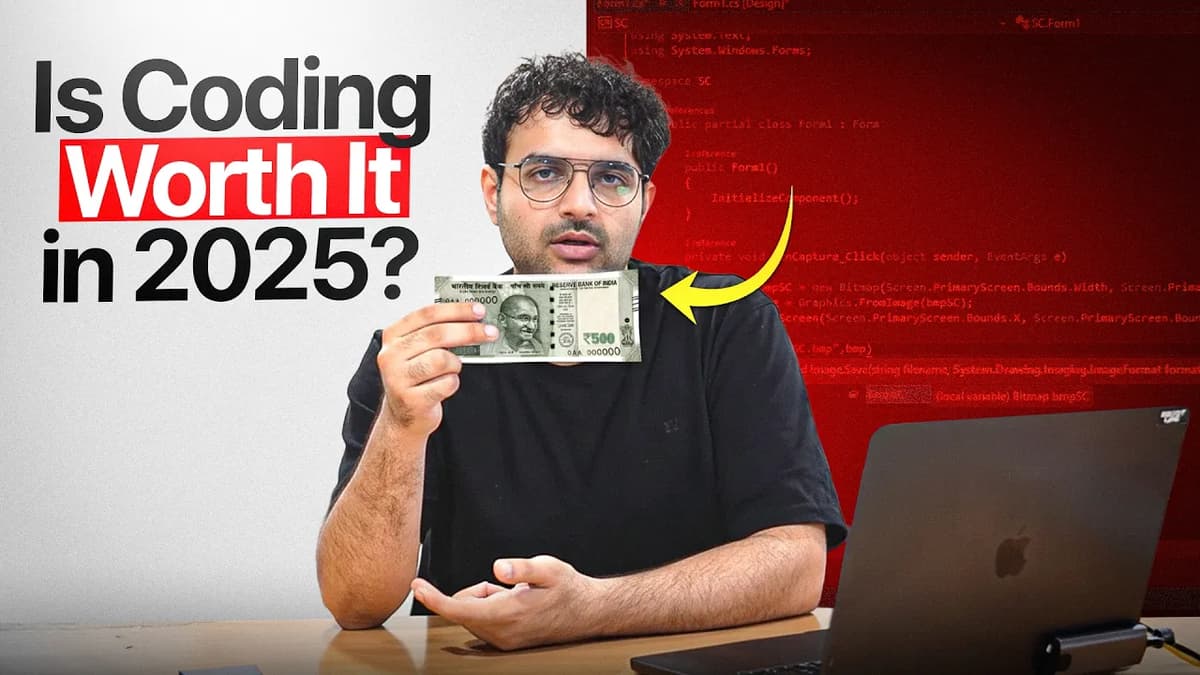
The tech market is up. Layoffs everywhere. People applying to hundreds of jobs and getting ghosted. AI slowly replacing tasks we thought were safe. Even if you already have a job, the ground never feels steady. This industry moves fast, and it forgets people even faster.
I want to ask the question most developers are scared to say out loud: is it still worth it?
Hey, I’m Medi. I’ve been coding professionally since 2012. I’ve led developer teams, and I’ve helped thousands of beginners learn to code through my channel and community. I’ve seen hype cycles and cool-downs. I’ve watched people pivot careers, build their lives around tech, and then watch the rug fly out from under them. And even after more than a decade in this space, I’ve never seen it feel this uncertain.
So I’m going to tell you the truth. Not to scare you, but to prepare you. Because no one told me this when I started, and it would have saved me from a level of burnout that hollowed me out from the inside.
The High That Turns Hollow
In my previous job, I was leading a team. On paper, things looked great. My work was solid. My numbers were good. I shipped. I unblocked other people. People came to me when it was time to solve the weird bugs and the messy cross-team problems.
My colleagues respected me. Performance reviews said I was exceeding expectations. I was the person folks pulled into meetings to translate chaos into a plan. It felt good for a while. It felt like proof that all the late nights actually meant something.
But slowly, something shifted. The better I performed, the worse I felt. Every win came with more nonsense. Every shipped feature invited a brand new pile of unrealistic deadlines, tasks that made no sense, and late night calls for things that weren’t even my responsibility.
I’m talking about the 11:47 pm Slack ping that starts with a friendly “quick question” and turns into a two hour emergency “because the deck goes to the VP tomorrow morning.” Or the Sunday morning “super tiny tweak” that somehow spirals into a surprise outage triage even though another team owned the service. You know the drill. A calendar that looks like Tetris. A backlog that grows when you breathe near it.
And the cherry on top? Getting told off by my boss for stuff completely unrelated to my work. I don’t mean constructive feedback. I mean walking into a meeting and feeling like someone was already angry, and they just needed a person to absorb it. You know that feeling that someone’s mad at you but not about you. They’re just looking for someone to dump it on.
I was exceptional in my role, and yet I felt invisible. That mismatch eats you from the inside. You start asking, why do I care so much if the system doesn’t? You try to shake it off, but it lands again the next morning.
I started to wake up with chest pressure. Not a metaphor. A tight band across my ribcage before my feet hit the floor. I would reach for my phone and scroll through messages, waiting for another urgent task that shouldn’t even exist. Before coffee. Before sunlight. Before a single quiet minute to remember who I am outside my job.
And in those moments, I wasn’t thinking about solving bugs or writing better code. I was thinking, how much more of this can I take? That’s when a darker thought hit me. One most developers won’t say out loud because it sounds like failure.
I knew I was doing a great job. My team told me. My peers told me. I had receipts. But the environment didn’t care at all. And that’s when I realized something that changed how I see this industry forever.
In tech, being great doesn’t protect you. Not from bad management. Not from layoffs. Not from burnout. I’ve been here long enough to watch people rise fast, burn out faster, and disappear quietly. I honestly never thought I would almost become one of them. I thought I was different. That’s how burnout sneaks up on you. It starts with the story you tell yourself about how you’re built for this. Then your body tells you a different story.
What really opened my eyes wasn’t just the exhaustion. It was seeing how fragile this whole system actually is. It looks sturdy from the outside. It’s not. It can turn like the wind.
The Market That Doesn’t Care
The last couple of years have been wild. One week, everyone is hiring and we’re “scaling fast.” The next week, half the team is gone. One quarter, we celebrate new headcount. The next quarter, we pretend all that momentum never happened.
If you’ve tried applying for a job recently, you already know how brutal it feels. You send a hundred applications. Maybe five replies. Two interviews. Then silence. No explanation. Just a progress bar that never moves, a cold “we decided to move forward” email that lands six weeks late, or nothing at all.
It’s not that you’re bad. It’s that the market stopped caring. There are too many devs chasing too few openings. When supply is high and attention is low, the default answer becomes no. Not because you can’t do the job. Because it’s easier to ignore you than to evaluate you fairly.
Companies want unicorns. Job posts ask for 5 years of experience for a junior role. They want “AI knowledge” for a front end job that barely touches server logic. They list a grocery cart of acronyms like it’s a personality test. It’s insane, really. You know this because you’ve read those posts and wondered if anyone is actually qualified for what they wrote.
I’ve seen amazing developers get rejected for the dumbest reasons. Wrong time zone. Wrong tech stack on the resume even though the skills translate in two weeks. Or just bad luck, like applying one day after the role quietly closed. When you peel back the curtain, it’s not a meritocracy. It’s a lottery with a skills check.
And the scary part? Even seniors aren’t safe. One budget cut. One email. One reorganization. Suddenly you are just a number on a spreadsheet. If you’ve ever sat in a meeting where someone says “we need to find 12 percent,” you know the chill I’m talking about. The math is clean. The human part is not.
At some point, I realized something I wish wasn’t true. The market doesn’t reward loyalty. It rewards luck. You can work your heart out for years and the next day someone in finance decides your position is non essential. It doesn’t matter if you’re the best coder in the world. You can be brilliant, helpful, the person who mentors everyone else, and still get replaced by a cheaper developer or an automation tool.
That thought haunted me because it meant all the effort, all the late nights, all the stress could disappear overnight. And no one, literally no one, would remember the details. The tickets you closed. The incidents you prevented. The edge cases you thought about that saved the company money. Gone from memory the second your accounts deactivate.
The faster you understand that, the less this industry can break you. You stop treating work as the full story of your worth. You start building safety in other ways. You learn to separate how good you are from how stable your seat is.
The Moment That Changed Everything
One night, I came home after another long day. Slack messages lighting up my phone during the commute. Puzzling deadlines quietly pushed forward. Last minute urgent requests for things that made zero sense. A carousel of “quick asks” that never end.
I dropped my bag by the door, sat down, and just felt it. That tight pressure in my chest again. Not because of the workload. Because I knew deep down, none of this was worth it anymore. Not like this.
I had done everything right. Led the team. Solved problems. Helped others. Made the company millions and millions of dollars. And yet I was being treated like I was one mistake away from being disposable. Like my value existed only in the next sprint, not in the years of proof behind me.
I was angry. I was frustrated. I was exhausted. And I was jealous. Jealous of people with simple, low stress jobs who could actually breathe after work. The person whose shift ends and then it actually ends. The kind of life where you can watch a movie without peeking at your phone every eight minutes like it’s a smoke detector.
I was paid well, but mentally bankrupt. That’s the trade nobody warns you about. You can be comped to the moon and still feel empty. Because money doesn’t fix a life built around dread.
I remember saying out loud, “Even when I’m great, it’s never enough.” And I meant it. I meant it in my bones.
That’s when my wife looked at me and said something that changed everything for me. We were in the kitchen. Kettle hissing. The room quiet in that heavy way it gets after a long day. She put the mug down, looked me in the eyes, and said it plain.
It hit me like a reset button. And it made me laugh for the first time in weeks. Not because any of it was funny. Because it snapped me out of the trance. She was right. I wasn’t tired of coding. I was tired of what the job had turned coding into. Anxiety, stress, and constant noise in my ears.
I realized I didn’t hate my work. I hated the version of myself I became to survive it. The always-on, never-resting, breadcrumb-chasing version. The person who measured their day by how many fires they put out instead of the life they were living.
That moment forced me to ask a different question. Not how do I make more money. Not how do I get promoted. But how do I stop letting this industry define my worth.
That’s when everything started to shift. Not instantly. Not like a movie. More like a train slowly choosing a different track. Tiny choices. Clearer boundaries. A new definition of what a win looks like. The pressure didn’t vanish, but I stopped handing it the keys to my head.
The Real Question: Is It Worth It?
If you’re learning to code right now, you’ve probably seen the fear everywhere. AI is taking our jobs. No one is hiring juniors. Tech is dying. The thumbnails are dramatic for a reason. Fear is good at getting clicks.
I get it. It looks scary. But here’s something real. The tech market isn’t dying. It’s growing up. Hype drains out, accountability moves in. Companies are asking harder questions. Slow is smooth, smooth is fast.
And here’s the thing. Every time the market resets, new opportunities are born. The people who adapt early, learn new tools, build side projects, and stay visible become the next wave of lucky. It looks like luck from the outside. On the inside, it’s iteration, timing, and being loud about what you can do.
Stop Building Another Todo App. Solve a Real Problem.
Pick one person or a small business. Ask what wastes their time. Listen properly. Don’t pitch. Then ship a tool that removes that one pain.
- Talk to the barber who spends an hour every Sunday tallying appointments in a notebook. Make a tiny page that auto-texts no-show reminders.
- Meet the bakery owner who screenshotted orders from WhatsApp and loses track by noon. Create a simple dashboard that turns messages into an order list.
- Help a local gym automate monthly attendance reports so they don’t manually count check-ins.
Use AI as leverage, not a crutch. This is not about generating whole apps with a prompt. It’s about shaving minutes and costs where it matters.
- Automate weekly reports so a founder gets a Monday morning summary without opening five tabs.
- Summarize customer emails so support can prioritize without reading walls of text.
- Generate invoices from WhatsApp messages so a freelancer gets paid faster with fewer errors.
When your projects save real minutes or real money, recruiters don’t need imagination. They see impact. They see a before and an after. That’s the difference between “nice project” and “we should talk.”
One Tiny Feature Per Week Beats Four Months of Overthinking
Keep a simple target: one problem, one tiny feature every week. This is the rhythm that gets you sharp without frying your brain.
- Week 1 - Identify the pain. Talk to a real human. Watch them use their current solution. Write down where they sigh.
- Week 2 - Create the prototype. Keep it ugly. Buttons that work beat pixels that shine.
- Week 3 - Polish the UX a little bit. Remove two clicks. Add one confirmation. Make it feel safe.
- Week 4 - Write a five line case study. Keep it laser focused: Problem. Solution. Result. Link. Next step.
Then repeat. Four weeks of this beats four months of still learning. Shipping beats studying when the goal is signal. You learn faster by dragging ideas into reality and watching where they break.
Zooming Out: What Makes It Worth It
The market is tighter now. It’s forcing us to be sharper, more adaptable, more human. So is it still worth it? That depends on why you’re here.
If you’re chasing easy money, fancy titles, or validation, you will burn out fast. The dopamine dries up, and then you’re left with a job you never liked in the first place. But if you love solving problems, learning, and building things that actually matter, then yeah, it’s still worth it. It’s worth it in a different way than the hype promised, but still worth it.
Just don’t expect the market to care about you. Make sure you care about you. The people who survive this industry aren’t the smartest or the fastest. They are the ones who know how to protect their energy, keep learning and adapting, and stay kind when everyone else is panicking.
Stop Playing the Job Hunt on Hard Mode
There are three levels of networking that actually move the needle. You don’t need to be loud. You need to be direct and relevant.
Level 1 - Referral
Ask someone at the company to submit you. It is basic, but it still works. People overcomplicate this. A respectful ask plus a clear resume gets you out of the applicant tracking black hole more often than not.
- Keep it short: “Hey, I’m applying to X. Based on Y and Z, I think I’m a fit. Would you feel comfortable submitting a referral? No pressure if not.”
- Make it easy: include the role link and your one line headline upfront.
Level 2 - Decision Maker DM
Send a short Loom or GitHub link that shows how your project relates to their product. Skip the small talk. Lead with value.
- Subject: “Cut your dashboard load time by 30 percent with 1 line change.”
- Body: 3 sentences. 1 - I’m Medi, built X that mirrors your Y. 2 - 90 second Loom showing the change and the metric. 3 - GitHub link or diff. Ask: want the patch?
Level 3 - Inbound
Post your projects weekly on X or LinkedIn. When your work is public, opportunities DM you. It feels slow at first. Then someone shares your post, and a recruiter who never checks their inbox sees your work in their feed.
- Format: before, after, metric, 1 screenshot, link.
- Frequency: weekly. Consistency beats bursts.
Your Resume Gets 10 Seconds. Make Every Line Count.
If you’re serious about standing out, start with the thing every recruiter sees first: your resume. Most will spend maybe 10 seconds on it. That means fluff is a luxury you cannot afford.
- One line headline: your role, your stack, your niche. Example: “Front end engineer - React, TypeScript - analytics dashboards.”
- Three bullet points with numbers. Examples:
- Reduced page load time by 35 percent on the main funnel.
- Shipped a feature used by 1,000 active users within 30 days.
- Saved support 4 hours a week by auto generating summaries.
- Link one live demo. Not a screenshot. A URL that works.
Cut anything that doesn’t prove what you can do. Recruiters don’t care that you “worked on many projects.” They care about impact. Replace filler with proof, numbers, results, or real users. If there’s no metric, add a quote from a real user. If there’s no quote, add a link they can click to see it live.
What You Can Actually Do Right Now
Keep building things that matter to you, even if no one’s paying you yet. Every project you finish makes you sharper, more confident, and harder to replace. Think of it as reps for your brain. Not wasted time. Investment.
Because the truth is, tech doesn’t owe you anything. But it can still give you everything if you stop trying to prove yourself to people who will never, ever notice. You don’t need to grind yourself to dust to be valuable. You need to keep building, keep improving, and keep your boundaries intact.
That line matters more now than it ever has. Tools change. You don’t. The way you think, the care you bring to a problem, the courage to ship when it’s scary. That’s the part no model can clone.
The Truth You Need To Hear
The brutal truth is, yeah, the market’s tough right now. People are losing jobs. Others can’t even get their first one. And you can do everything right and still get rejected, ignored, or replaced. That is real. It is not a reflection of your worth.
But that doesn’t mean it’s not worth it. Because this path, learning to code, building, struggling, it changes you. It forces you to think when you’d rather numb out. It makes you grow when nothing makes sense. It teaches you patience, discipline, and resilience. Those things will outlast any job title or company name. Believe me.
Maybe that’s what makes this path special. You don’t just build apps. You build yourself. The market can take away your job, but it can’t take away your ability to build things, solve problems, or reinvent yourself. That’s the real moat. That’s what makes it worth it.
If you’re in that dark place right now, if you’re tired, rejected, burnt out, remember this: your value doesn’t disappear just because a recruiter didn’t see it. Be great, but don’t lose yourself trying to prove you are. Because when everything else falls apart, the only thing that still matters is who you became while you were building.
Try This: A 30 Day Micro Challenge That Builds Through the Uncertainty
Structure beats chaos. If you want a way to get moving when your brain is foggy, do this with me for 30 days.
- Daily - 20 to 40 minutes. Build one feature or fix one bug. Keep a timer. Stop when it rings. Leave wanting more.
- Weekly - Ship a tiny release and write a five line post with a screenshot:
- Problem - what hurt and for who.
- Solution - what you shipped.
- Result - one metric or one quote.
- Link - live demo or repo.
- Next step - what you’ll do next week.
- Day 30 - Post a 60 second demo. Share it on Instagram or drop it in our Discord.
I will check them out and give feedback. Not fluffy praise. Tight, useful notes that help you ship the next thing cleaner and faster. Because the best way to fight uncertainty is to build through it.
Keep Going. I’m In Your Corner.
If this hit you even a little, leave a comment. I read every single one. Drop a like if you found value. Subscribe if you want more real talk about coding and career growth.
If you want to connect deeper, you’ll find me on Instagram and inside our Discord community where thousands of developers are figuring this journey out together. We share wins, ship small, and keep each other honest.
Thanks for reading. I’m Medi, and I’ll see you on the next one. Until then, keep learning, keep building, and take care of yourself. Bye.